


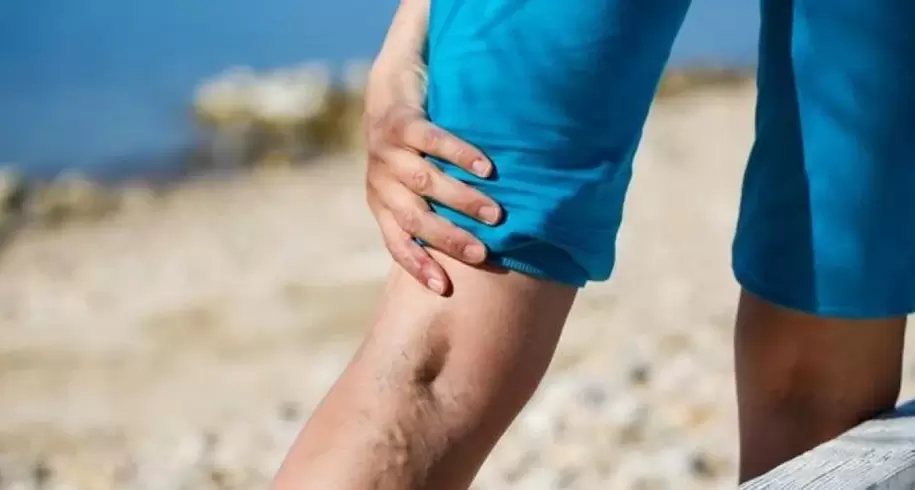
Veins have valves that normally block or open the flow of blood in the vessels.Since blood flow in the veins is directed from the tissues to the heart, the valves' job is to prevent venous blood from returning to the veins of the lower extremities.
When the elasticity of the vessel wall decreases and the vein dilates, the valves do not regulate blood flow and varicose veins develop, which is characterized by stagnation of venous blood in the veins.That is, blood cannot be transported normally from the legs to the heart - it is constantly delayed.
With varicose veins, the superficial veins in the legs become blue or dark purple in color and appear lumpy, bulging, and misshapen.With varicose veins, veins do not always protrude to the surface, since they can be located deep in the tissues of the lower extremities.Because of this, leg pain often confuses people because there is no apparent reason for the pain.
Varicose veins need to be treated, as they can lead to thrombophlebitis - inflammation of the venous wall.With thrombophlebitis, blood clots form; if they enter the pulmonary circulation, a person may die from pulmonary embolism, in which a blood clot clogs vital vessels.
Causes of varicose veins
Varicose veins in the legs occur due to decreased elasticity of the venous wall and valvular insufficiency.The development of varicose veins is promoted by:
- sedentary lifestyle and prolonged standing work.More often develops in office workers, weightlifters, dentists and surgeons;
- hereditary predisposition;
- female gender: women suffer from varicose veins more often than men, since “female” hormones estrogens negatively affect the venous wall.In addition, during pregnancy, pressure in the veins of the pelvis and lower extremities increases, so the risk of developing varicose veins of the lower extremities becomes higher.
- congenital weakness of the vascular system;
- Klippel-Trenaunay-Weber syndrome, in which pathological messages are formed between the arteries and veins, promoting the reverse outflow of venous blood.
Symptoms of varicose veins
Varicose veins can be symptomatic and almost hidden.In the first case, the symptoms of varicose veins are as follows:
- discomfort and aching pain in the lower extremities;
- swelling in the ankles;
- burning or throbbing sensation in the legs;
- convulsions that occur mainly in the evening or at night;
- itching over the area of the dilated vein;
- rapid fatigue of the legs;
- changed skin color.
These symptoms become more pronounced in the evening, at the end of the working day, during the warm season and after a person has stood for a long time.With hidden varicose veins, there are no external signs of varicose veins, but there is pain in the legs.
Typically, pain in the lower extremities is severe and deep in the legs.Often, pain can signal phlebitis (inflammation of the veins) and the formation of blood clots.The development of thrombophlebitis is accompanied by an increase in body temperature.
An enlarged vein can burst and then a bruise occurs in the place where the affected vessel passes.Skin ulcers can occur even after minor damage to the skin.Typically, varicose vein ulcers are small, superficial, and painful.
The danger of phlebitis, thrombosis and thrombophlebitis - the difference between thrombosis and ulcers in varicose veins of the legs is that they lead to the development of small blisters with thin walls on the ankles.These blisters are easily damaged and bleed.The blisters may rupture while you sleep, which can lead to minor bleeding.
Varicose veins of the lower extremities lead to other skin and vascular pathologies:
- lymphadenopathy.An enlarged vein can damage the vessels of the lymphatic system, which transport and dispose of toxins and metabolic products.Also, damage to the lymphatic vessels can lead to lymphedema, which causes swelling of the lower extremities;
- dermatitis, which is accompanied by itching and rash in the area of varicose veins.Most often, the rash is localized on the lower leg and ankle joint.Dermatitis can lead to minor bleeding, skin irritation and infection.
How to treat varicose veins?
If the symptoms of varicose veins are mild, preventive measures prescribed by a phlebologist (treats vein diseases) are sufficient.But when varicose veins cause discomfort, such as pain, cosmetic defects, tired legs, swelling or changes in skin color, therapy is needed, which consists of the following methods:
- compression stockings, which moderately compress the legs and veins of the lower extremities so that the blood in them does not stagnate.Compression stockings can help relieve pain and swelling.For the symptoms to go away, stockings must be worn for at least 6 months.Also, wearing stockings should be combined with regular physical activity, which mostly involves the legs: running, exercise equipment, cycling;
- radiofrequency ablation.This is a minimally invasive method: a disposable catheter is inserted into the vein, which is heated and causes the vein to collapse.As a result, the vein closes and venous blood flows to the heart through healthy veins;
- sclerosing therapy.The doctor injects a medicine that turns a section of the vein into connective tissue, as a result of which the lumen of the vein closes and the blood is transported to neighboring healthy vessels;
- surgical methods that involve ligation or complete removal of the affected vein.
How to treat varicose veins on the legs in women?
Treatment of varicose veins does not depend on gender: for women it is the same as for men.However, there are particularities of therapy for pregnant women.Varicose veins in pregnant women increases the risk of obstetric and vascular complications, can lead to unstable development of pregnancy and increases the incidence of toxicosis in pregnant women.Therefore, special attention is paid to the treatment of varicose veins in pregnant women.
Surgical treatment is used in extreme cases, when varicose veins are accompanied by venous insufficiency and complications, for example, the formation of trophic ulcers or thrombotic pathologies.Microinvasive methods such as sclerotherapy and radiofrequency ablation are contraindicated during pregnancy.Also, women during pregnancy are rarely prescribed hormonal drugs and non-steroidal anti-inflammatory drugs.
The main method of treating varicose veins in women is conservative therapy in the form of compression (compression stockings) in combination with drugs that improve the nutrition of the walls of blood vessels (phlebotropic agents).If compression therapy is ineffective, doctors prescribe agents that do not penetrate the placenta and do not affect the fetus.
Complications of varicose veins
Untreated varicose veins can be complicated by trophic ulcers, acute thrombophlebitis and bleeding from the affected veins.
Trophic ulcers most often form on the inner surface of the lower leg and above the ankle.The first signs of developing ulcers are dermatitis: the skin becomes inflamed and very itchy.Then single and multiple small painful ulcers form, from which pus or inflammatory fluid is released in small quantities.
In acute thrombophlebitis, compactions appear on the superficial veins, accompanied by pain and redness along the vein.A patient with acute thrombophlebitis has difficulty walking due to discomfort and pain in the legs.A thrombosed vein can rupture.Then profuse bleeding occurs, which leads to massive blood loss.
Prevention of varicose veins
To prevent varicose veins in men and women, you need to follow the recommendations.The most effective tips and techniques:
- always prefer physical activity to immobility, for example, instead of the elevator, climb the stairs yourself, if you need to go 1-2 stops, do not take public transport and walk;
- watch your weight – excess body weight is a provoking factor for varicose veins;
- An active lifestyle is the key to preventing varicose veins.However, physical activity should be reasonable.Weightlifting is not recommended as heavy lifting puts a lot of pressure on the legs and causes blood to stagnate in them.The best sports for the lower extremities are running, cycling, swimming, and aerobics.Choose an activity that involves your lower leg and ankle, such as soccer or skiing;
- if you have a sedentary lifestyle, get up from your chair every 40 minutes and do a little warm-up: sit down 5-10 times or just walk;
- choose non-restrictive shoes without high heels, try to walk barefoot as often as possible;
- walking for at least 30 minutes a day, at least 3-4 times a week;
- If you have a standing job, purchase compression stockings and wear them while you work.This way you tone the veins of the lower extremities and blood does not stagnate in them.
If your legs hurt for no apparent reason, there is fatigue and swelling, and curved blue or purple veins appear on your skin, you may have varicose veins of the lower extremities.Do not delay treatment and consult a doctor for advice and diagnosis.